As the world marks Environment Day on June 5, Yomal Senerath-Yapa visits the threatened Anavilundawa wetlands where the WNPs together with the Wayamba University and Wildlife Dept. is involved in restoring a critical ecosystem.
Some of the sun-baked plains within the Anavilundawa Bird Sanctuary located between Chilaw and Puttalam are not verdant and lush, but shimmer white in the morning sun. Lapwings and Black-winged stilts rise from their dry shrubs and circle the cerulean sky.
But someday these wastes will be flooded, and the pleasing green abundance of mangroves with their thick roots will cluster the margins of waters. Then will wing the Pied kingfisher, the Stork-billed kingfisher, the Cotton pygmy goose and the pretty, Fulvous whistling-duck in their numbers.
Such is the Edenic vision of the Department of Wildlife Conservation (DWC) and the Wildlife and Nature Protection Society’s (WNPS) Accelerated Natural Regeneration of Mangroves project within this RAMSAR wetland. It is aimed at restoring a critical ecosystem that is crucial to stabilizing the coastline, protecting water quality, reducing coastal flooding and also contributing to the economy and creating jobs.
The WNPS is the key science partner for the project. In their 130-year journey, morphing from the Ceylon Game and Fauna Protection Society into the Wildlife Protection Society, their milestones are establishing the national parks Yala and Wilpattu and working for the establishment of the Department of Wildlife Conservation itself.
The mangrove cover, says Graham Marshall, President of WNPS, was once abundant on the Western coastline. But 50 percent of the island’s mangroves has vanished within the last two decades; only around 17, 000 hectares remain today.
A major toll was taken by prawn farming, and in the case of Anavilundawa, a prawn farm established in 1986 here is wholly responsible for its bleak heath.
Surrounding this area are lush mangroves in their original state. After the prawn farm was abandoned in 1991 the dykes the farm had created and the introduced chemicals in the soil, ensured it would not be reclaimed naturally by neighbouring mangroves.
We were given a glimpse of the erstwhile splendour of this plot when Graham led us on a mangrove safari through those pristine stretches of the Anavilundawa Sanctuary.
The light, blue plastic theppama (the flat fishing craft used in lagoons) rocked when we gingerly stepped on, but Sampath from nearby Muthupanthiya steered adroitly under bridges and through the mangroves, under cool dark cavernous growths like dappled coves while kingfishers darted in and herons posed elegantly.
Here are found 13 species of true mangrove plants out of the total of 21 found in Sri Lanka. When restoring, only these 13 species are used and seeds have to come from mother plants strictly within Anavilundawa (even seeds from nearby Chilaw won’t do) – so sensitive are these organisms.
When restoring mangroves, site selection is key. Restoration is not the same as replanting, and aims at creating a whole ecosystem and its services. The aim is not to ‘recreate’ the state (in this instance) pre-1986, but an ecosystem suited to conditions today.
The chosen sites should have no sea grass beds and must have good soil and water quality.
The plots are watered by the Dutch (Hamilton) Canal. The theppama took us to the far reaches of the plot where above the whitish sun-burnt plains shore birds are seen pirouetting amidst white clouds in an impossibly blue sky.
Cut into this azure, ochre and green land are the canals where mangroves have been planted. The older canal systems are perfectly fishbone-shaped seen from above.
The later ones, however, are not symmetrical, the sub-canals tending to snake wildly.
The reason, explains Graham Marshall, is that these later ones follow contour mapping. The Sri Lanka Navy’s Hydrographic Unit spent one and a half months producing a contour map of the whole site. While the fishbone canals were an 80% success, the later pattern easily would score a hundred percent.
Thilina Kumarasiri, postgraduate student and senior research officer attached to the WNPS, is one of those passionate about nature. In their green lab he plies us with thambili and talks about a project that has become an all-embracing passion.
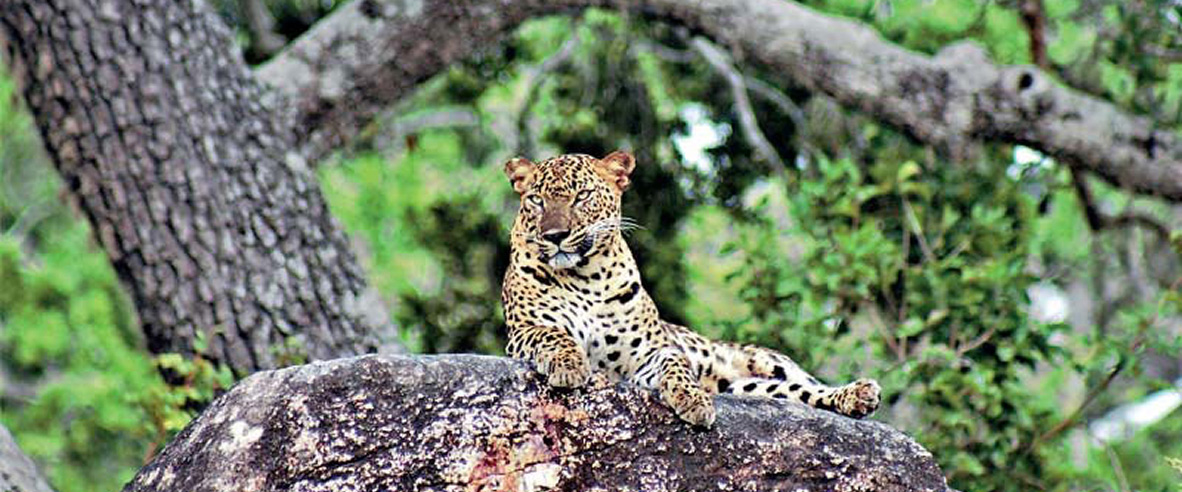
Thilina and the young team, all drawn from the University of Wayamba which is a key partner in the project, reside nearby. Some thrilling experiences they have had include spotting fishing cats (as elusive as- if not more than – the leopard) in the moonlight, coming across jackals and venomous snakes.
Near the lab, in the deep shade, Graham points out last season’s nurseries. While some species can be planted direct, others need tender care for three to four months. They are watered at least twice a day.
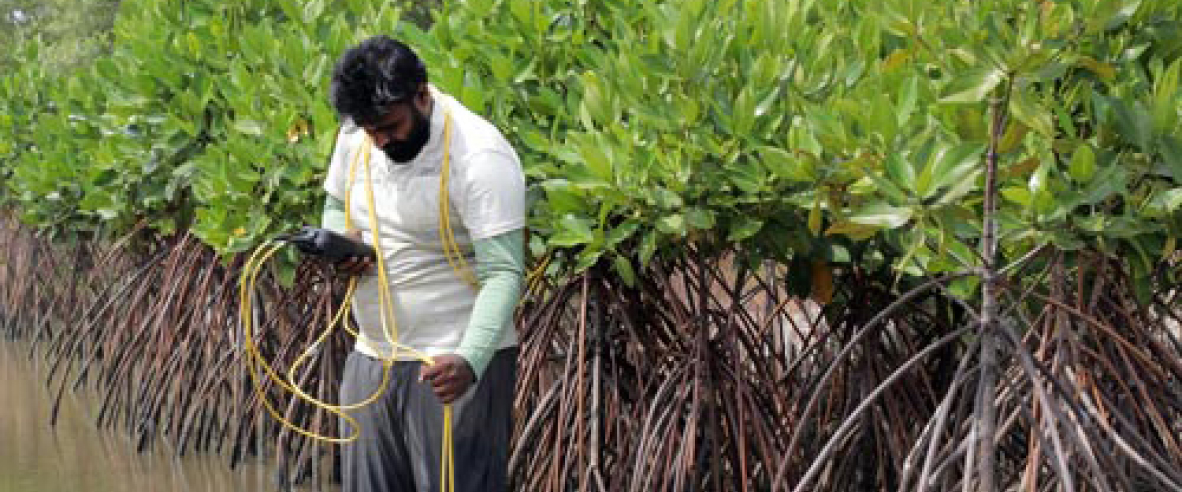
Random plants are tagged both in nursery and plot, and every two months the research team checks details like height, inter nodal distance, distance between two mature leaves on top, length and width of a leaf, the number of stilt roots and prop roots, etc. All this goes to a database and is sent to the Ministry of Environment.
Regular surveys keep the teams busy: the phenology survey (in order to make the first mangrove phenology calendar in Sri Lanka); a bird survey; a butterfly survey (more than 85 species so far ticked) and a water quality survey.
Enlightening the community is important, and instead of befuddling them with jargon, the team informs how more mangroves mean a better prawn and crab harvest to keep the home fires burning.
It was a major triumph to convince the community, and today they are a thriving part of their kadolana site eka– cooperating readily.
Says Thilina, “While on the one hand we have professional experts like Prof. Sevvandi Jayakody (see box), we also have the local experts”: the traditional knowledge the villagers have of mangroves is priceless and can sometimes be more beneficial than textbook science.
Thilina says they also work on educating local schoolchildren and some from Muthupanthiya and some Colombo schools have visited the project.
The mangroves are finally a lifeline for the community. The plants themselves can be used to manufacture products from charcoal pencils to herbal tea. The team is also looking to have mangrove safaris at night for tourists when fireflies create an atmosphere that is unforgettable, twinkling in their millions amidst the groves.